

The kitchen is the most task-intensive room in the house and yet it's consistently the most underlit. Most Malaysian kitchens rely on a single row of fluorescent tubes or a couple of downlights, and the result is a working environment that makes cooking harder, less safe, and frankly less enjoyable than it should be. This is one of the most straightforward problems to fix, and the improvement in how the kitchen functions is immediate and significant.
Why Kitchens Need More Thought Than Most Rooms
A bedroom is primarily about atmosphere. A living room balances comfort with function. But a kitchen is genuinely a workspace one where you're handling sharp knives, judging whether food is cooked through, reading small text on packaging, and working with heat. These activities require clear, accurate visibility in a way that most other rooms simply don't.
Poor kitchen lighting doesn't just create an atmosphere problem. It creates a functional problem. Work that's harder to see is work that takes more effort, produces more errors, and is less safe. Getting the kitchen lighting right is as much about making the space work properly as it is about how it looks.
The Problem With a Single Overhead Source
A central ceiling fitting in a kitchen has a specific weakness that makes it particularly problematic for cooking: your body. When you stand at the counter to prepare food, you position yourself between the ceiling light and the work surface. Your own body casts a shadow across exactly the area where you're working, which means you're often working in your own shadow without realising it.
This is the most consistent complaint about kitchen lighting "it's bright enough in the room, but the counter is always dark." It's not a brightness problem. It's a positioning problem. And the solution isn't a brighter ceiling fitting, because the shadow remains regardless of intensity.
Under-Cabinet Lighting Is the Most Practical Addition
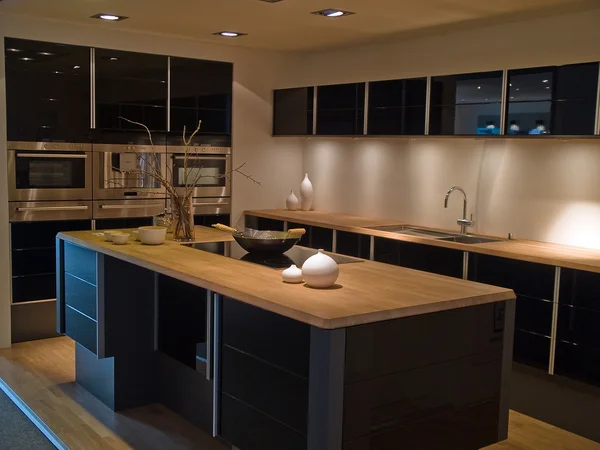
The solution to counter shadow is lighting positioned below the overhead cabinets, at the level of the work surface itself. Under-cabinet lighting whether LED strips, small puck lights, or slim linear fittings illuminates the counter directly and eliminates the shadow problem entirely.
This is one of the most impactful lighting additions in any kitchen. The work surface becomes genuinely visible, food preparation becomes easier and more accurate, and the kitchen feels like it's actually designed for cooking rather than just for general habitation. If you're doing a kitchen renovation, plan for under-cabinet lighting from the start. If your kitchen is already fitted, it can often be retrofitted without significant structural work.
Choose Neutral to Slightly Cool Light (4000K–5000K) for Task Areas
Colour temperature matters in the kitchen for practical reasons. You need to see the colour of food accurately to judge whether meat is cooked through, whether vegetables are fresh, whether a sauce has reached the right colour and consistency. Warm light in the kitchen can make these judgements harder, because it shifts how food colours appear.
Neutral to slightly cool light in the 4000K to 5000K range provides clarity and colour accuracy without the harshness of very blue-white light. It makes the kitchen feel bright and functional appropriate for a working space while still being comfortable to spend time in.
Separate Your Lighting Zones
A well-designed kitchen benefits from at least two distinct lighting zones with independent control: general ambient light for the overall space, and task lighting for the counters and cooking areas.
This separation gives you flexibility. When the kitchen is in full cooking mode, both layers are active. When you're just making a cup of tea, the ambient layer alone is sufficient. When the kitchen flows into an open-plan dining or living area, the ability to reduce kitchen brightness while maintaining ambient light elsewhere makes the transition between spaces feel more natural.
Don't Overlook the Island or Peninsula
If your kitchen has an island or peninsula, it deserves dedicated lighting almost always a pendant or a series of pendants positioned above it. This serves multiple purposes: it defines the island as a distinct zone within the kitchen, it provides task lighting at that surface, and it adds a strong visual element that contributes significantly to the overall aesthetic of the space.
For a standard kitchen island, two pendants work well for most lengths. For a longer run, three pendants give better distribution and balance. Spacing should be even, and the pendants themselves should be consistent in size and style for a clean, composed effect.
The kitchen is where you spend a significant amount of time every day. Lighting it well with appropriate colour temperature, dedicated counter lighting, and properly separated zones makes every use of the space easier, more enjoyable, and more accurate. If you'd like to talk through what your kitchen needs, we're genuinely happy to help.