

Unravelling LED Construction: How Your Lights Are Actually Made
You flick a switch and the room lights up. From the outside, it is simple enough. But what is actually happening inside that LED fitting? Understanding how LEDs are built helps you make smarter purchasing decisions and explains one of the most common frustrations in home lighting: why two bulbs at exactly the same wattage can produce completely different quality of light. The answer lies almost entirely in construction, specifically in three core components that determine everything about how an LED fitting performs over its lifetime.
The LED Chip: Where the Light Comes From
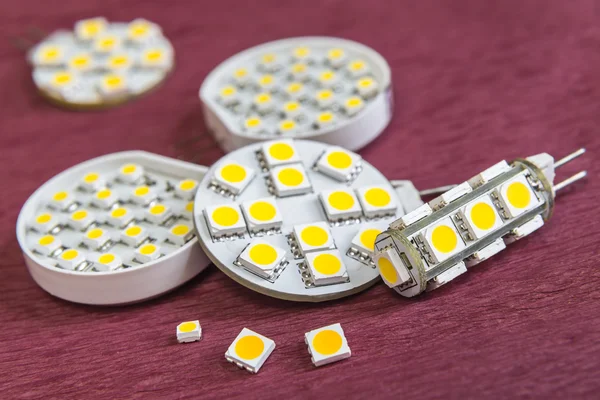
At the heart of every LED fitting is a semiconductor chip. This small electronic component emits light when electrical current passes through it, through a process called electroluminescence. Electrons within the semiconductor material release energy in the form of photons when current is applied. The colour of light emitted depends on the specific semiconductor material used and its composition, which is why different chips produce different colour temperatures.
What separates a good chip from a poor one comes down to the quality of the semiconductor materials, the precision of the manufacturing process, and the rigour of quality control applied during production. High-grade LED chips are manufactured to tighter tolerances, which means their colour output is more consistent and predictable. They maintain their brightness and colour stability over a much longer period. They also handle heat more effectively, which matters because heat is the primary cause of LED performance degradation over time.
Chip size varies considerably across product categories. Tiny 1mm chips are used in LED strips and decorative applications. Larger COB designs, which stands for Chip-on-Board, mount multiple chips together on a single substrate and are used in high-output downlights, spotlights, and linear fittings where concentrated brightness from a compact source is required. COB designs typically offer better lumen density and more uniform light distribution from the emitting surface.
The quality of the chip is what largely determines your Colour Rendering Index, or CRI. A high-quality chip produces a broad, well-balanced spectrum of light that includes all the wavelengths needed to render colours accurately. A cheaper chip may produce an apparently white light but with gaps or imbalances in its spectrum that cause certain colours to appear dull, flat, or subtly wrong.
Chip quality also determines how well the fitting holds its performance over time, a characteristic known as lumen maintenance. Quality chips from reputable manufacturers maintain 70 percent or more of their original output after 50,000 hours of operation. Budget chips may show visible dimming within 12 to 18 months of installation, a gradual process that many people do not notice until one day they realise the room seems significantly darker than it once was. The chip has not been replaced. It has simply degraded because the quality of the original component was not sufficient to sustain performance over time.
The Driver: The Unsung Hero of LED Performance
The LED driver is the electronic component that converts mains power, which in Malaysia runs at 240V alternating current, into the low-voltage direct current that the LED chip requires to operate. This is not a trivial conversion, and the quality of the driver has an enormous impact on the performance, longevity, and safety of the fitting.
A well-designed driver performs this conversion efficiently and stably, delivering the right voltage and current to the LED chip regardless of fluctuations in the mains supply. Malaysian mains power can vary in quality depending on location and local infrastructure. A well-designed driver compensates for these variations and ensures the chip operates within its specified parameters at all times. A poorly made driver may pass voltage fluctuations through to the chip, causing stress that accelerates its degradation.
Driver quality is also what determines whether a fitting flickers. Perceptible flicker, where the light visibly pulses, is immediately uncomfortable and completely unacceptable. But subperceptible flicker is the more insidious problem. Budget LED drivers often produce flicker at frequencies, typically 100Hz or 120Hz, that fall below the threshold of conscious detection but are nonetheless registered by the visual system over time. This type of flicker is a known contributor to eye strain, headaches, and general fatigue in people who spend extended periods under the affected light. It is the kind of discomfort that builds gradually through the day and that most people attribute to other causes, such as screen time or stress, without realising the ceiling light above them is the source. Quality drivers eliminate this entirely by maintaining genuinely stable current delivery to the chip.
When an LED fitting fails prematurely, it is almost always the driver that has failed rather than the LED chip itself. Chips designed for 50,000 hours or more of operation routinely outlast the drivers that power them in budget products, because the driver was the limiting component from the beginning. This is also why quality fittings from reputable manufacturers can be serviced with a driver replacement rather than requiring the entire fitting to be discarded. Budget fittings are rarely designed with this in mind. When the driver fails, the whole fitting goes in the bin and the cycle begins again.
Modern drivers also handle dimming, and the quality of dimming performance is another area where the gap between budget and quality products is significant. A well-designed dimmable driver reduces brightness smoothly and consistently from full output to a low minimum, without flickering, buzzing, or unexpectedly dropping out. Budget dimmable drivers frequently produce one or more of these problems, such as flickering at certain brightness levels, audible humming that increases as the dimmer is reduced, or the fitting simply cutting off below a certain point.
The Enclosure: Protection, Thermal Management, and Optical Performance
The housing around the LED components serves several critical functions simultaneously. It protects the electronics from the environment, manages the thermal performance of the fitting, determines the optical characteristics of the light output, and defines the visual form of the product.
Heat management is the most technically important of these functions. LEDs produce heat during operation, and that heat, if not effectively moved away from the chip and driver, accelerates the degradation of both. The enclosure acts as a heat sink, absorbing thermal energy from the electronics and dissipating it into the surrounding environment. This is why quality LED fittings use aluminium housings. Aluminium is an excellent thermal conductor, and its high surface area relative to mass makes it very effective at releasing heat. A fitting that remains cool to the touch after extended operation is one whose thermal management is working correctly. A fitting that runs hot is one that is shortening its own lifespan with every hour of use.
The enclosure also determines the IP rating, the degree to which the fitting is sealed against dust and moisture. This is achieved through the material quality, the precision of joints and seals, and the design of cable entry points. A fitting with a high IP rating is one whose enclosure has been engineered to maintain its sealing integrity under the conditions its rating specifies. A fitting with a low or unspecified IP rating is one where the enclosure design has not been held to this standard.
The optical design of the enclosure, including the internal reflectors, lenses, and diffusers that shape and direct the light output, determines the beam angle, the evenness of light distribution, and the overall visual comfort of the fitting. A well-designed optical system produces a smooth, even beam of the specified angle without hot spots or harsh edges. A poorly designed optical system produces uneven distribution, visible bright centres, or uncomfortable beam characteristics.
When you compare two fittings at very different price points, the difference almost always comes down to these three components: the chip, the driver, and the enclosure. These are the elements that determine not just how your lights perform on day one, but how they perform three, five, and ten years down the line. Understanding this is what allows you to make a genuinely informed decision rather than simply buying based on price or appearance alone.